A Boutique Residential Idea Designed for Modern New Cairo Living
Kairo is one of those residential projects in New Cairo that becomes easier to understand the longer you look at it, not because it tries to impress with endless claims, but because its concept is clear from the start. It is positioned as a boutique residential community with a limited-unit lifestyle, and that framing alone places it in a specific category. Instead of presenting itself as a large-scale destination that tries to include everything, Kairo reads more like a residential address with a defined identity. In a city where residential options have expanded massively over the past years, this type of clarity matters. Many projects can feel similar on the surface, especially when the language used across the market is built around the same themes, comfort, modern living, convenience, and lifestyle. Kairo is interesting because it does not depend on a long narrative to explain what it is. Its format does the explanation, a compact footprint, a limited number of units, and a “hotel apartment” positioning that signals a specific living style.
The reason this matters is simple. A modern residential concept is not only about architecture or finishes. It is about structure, and the feeling a place creates in everyday life. Modern living, for many residents, has become about fewer complications, smoother routines, and a home that feels intentionally planned rather than randomly assembled. This is where boutique residential formats fit naturally. They are designed around control, predictability, and a sense of cohesion. Kairo sits inside that logic. It proposes a form of modern living that feels organized, refined, and efficient, without needing to be oversized or overly complex to justify itself.
A boutique scale that defines the experience before you even enter
Kairo’s concept becomes tangible the moment you look at the numbers behind it. The project sits on a total land area of 8,397 square meters and includes 103 units. These are not random details. They tell you what kind of community this is. A smaller unit count changes the social rhythm of a residence. It often creates less density, less pressure on shared circulation, and fewer moments where the place feels busy simply because too many people are sharing the same space. That difference may sound subtle on paper, but it becomes real once you start thinking about daily movement, entry and exit patterns, and how often you want your home to feel like a calm base rather than a crowded system.
A boutique scale also creates a different relationship with privacy. In many cases, privacy is not only a function of high walls or distance. It is a function of how many residents are sharing the same environment. When a project is designed with a limited number of homes, it can naturally feel more private without forcing that privacy through isolation. This is the kind of privacy that comes from fewer interruptions, fewer shared bottlenecks, and a more contained space that keeps its identity consistent.
What’s also important is that boutique projects are easier to keep coherent. Large communities often have multiple zones, phases, and internal variations. That can be great for variety, but it can also create an uneven identity where the experience changes depending on which part of the project you are in. Boutique projects can feel more unified because they are built around one concept, delivered as one product, with fewer moving parts. Kairo is shaped by that principle. It is a smaller residential environment designed to feel complete as one whole.
The hotel-apartment format as a modern housing choice
One of the most defining parts of Kairo’s identity is its positioning around hotel apartments. In the market, people sometimes treat this phrase as marketing language, but it is actually a clear residential format. Hotel-apartment living points to a specific idea, homes that feel more structured, more managed, and more aligned with a certain standard of daily convenience. It often implies a residential atmosphere that feels clean, refined, and intentionally presented.
This format tends to appeal to people who want their home to feel like an address rather than an endless project. There is a difference between living in a place that feels like a neighborhood and living in a place that feels like a residence. A neighborhood can be wide and diverse, with many different forms of living inside it. A residence is usually more contained. It has a clearer rhythm. It feels easier to understand. Kairo’s concept leans toward the second category. It offers a modern residential idea built around structure, which is exactly why the hotel-apartment angle fits.
Another reason this format is relevant is that modern living in New Cairo has increasingly shifted toward practicality. People want comfort, but they also want a home that supports fast routines. They want the experience to feel polished, but also simple. Hotel-apartment style living often sits in that space. It is not about excessive luxury. It is about clean living, smart organization, and a residence that feels designed for real daily use rather than occasional presence.
A vertical layout that keeps the community structured
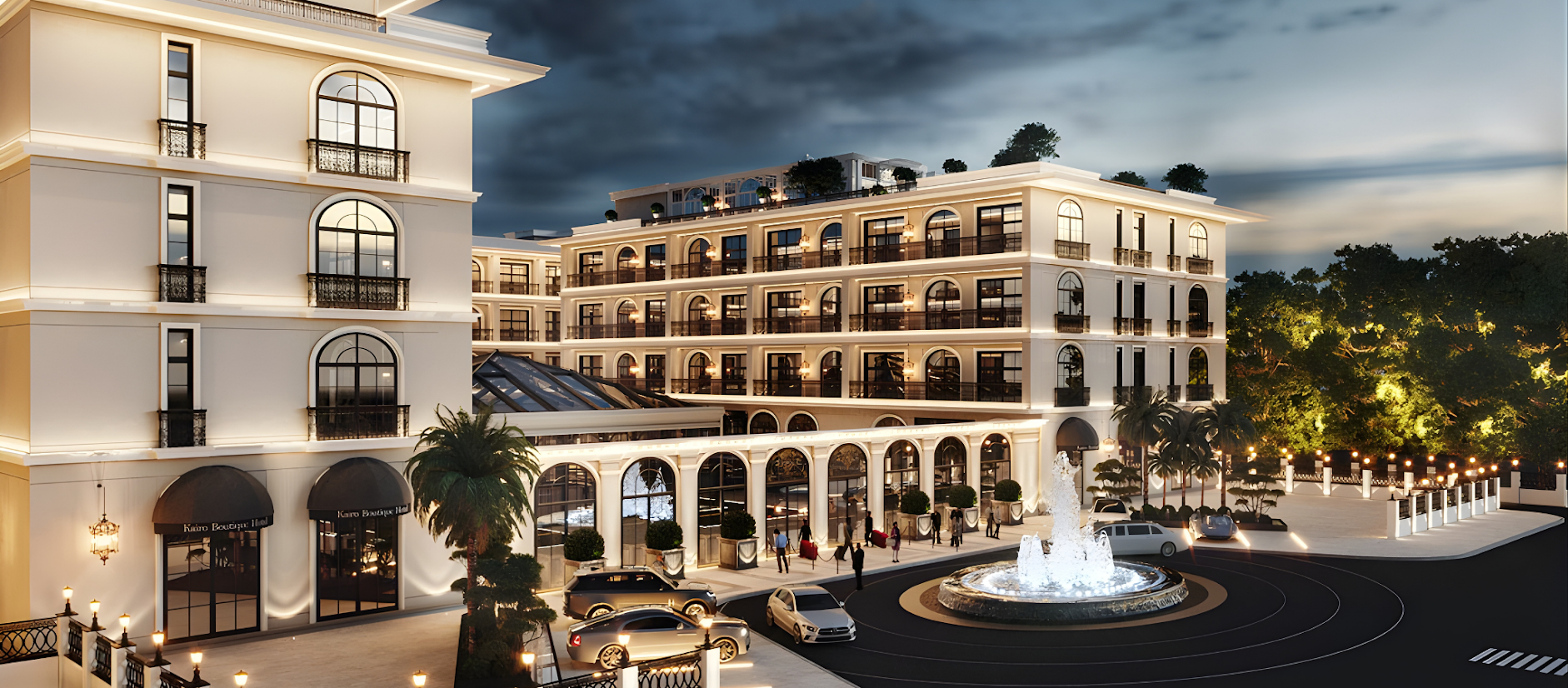
Kairo’s building structure supports this concept in a very direct way. The project is described as having a ground floor, three typical floors, and a penthouse level. This detail shapes the living experience more than many people realize. Vertical residential living creates a different sense of movement compared to sprawling communities. It reduces internal distance. It keeps spaces closer. It supports the idea of a contained, boutique residence where the community feels unified rather than spread out.
This layout also reinforces the idea that Kairo is designed as one complete architectural product. It is not a set of disconnected blocks or zones. It is a defined residential form. For many residents, that brings a sense of clarity. You know what the building is. You know how it functions. You know what the community looks like structurally. This is one of the most practical aspects of modern living, a residence that feels predictable in a good way.
Vertical structures also support efficiency. They can allow for smoother circulation patterns, simpler navigation, and a more direct relationship between the unit and the shared environment. That efficiency matters in modern living because residents increasingly value time and ease. A home is not just a place you return to. It’s a base you move through. The easier that base is to navigate, the more it supports daily life without creating extra friction.
Modern design is not only aesthetics
When people say “modern residential concept,” they often imagine sleek facades and minimalist interiors. But the real modern shift in housing is not only visual. It is conceptual. Modern living prioritizes clarity, reduced complexity, and spaces that feel designed around the resident’s daily life rather than around a generic vision. Kairo fits this understanding of modern because its concept is built around deliberate limitations. It limits the unit count. It keeps the footprint contained. It chooses a specific format. It presents one identity and sticks to it.
This type of intent is what makes a project feel concept-driven. A concept-driven residence isn’t one that claims to have everything. It’s one that understands what it is and builds around it. Kairo’s identity is not scattered across multiple themes. It is centered on being a boutique residential address in New Cairo with a hotel-apartment format and a controlled community scale. This is a coherent concept, and coherence is one of the rarest qualities in fast-growing residential markets.
A limited-unit lifestyle, and why it matters more than it sounds
The phrase “limited-unit lifestyle” is not just a description. It is a way of explaining how the residence might feel from day to day. In practical terms, fewer units means fewer unknowns. It can mean fewer people sharing the same spaces. It can mean a calmer sense of movement. It can mean less variation in how residents use the place, and that consistency often shapes the environment. When the population of a residence is smaller, the residence tends to feel more stable. It is easier to maintain a consistent atmosphere.
In modern Cairo living, stability is a key value. People deal with enough chaos outside the home. They want the home environment to feel more controlled. The limited-unit concept becomes a direct response to that preference. It is not about exclusivity as a claim. It is about predictability as a benefit. Predictability is what makes a home feel restful, because it reduces surprises, and it reduces daily friction.
This is also why boutique projects have become more interesting over time. They offer a living experience where the environment feels designed for people who want a clean routine. They don’t always want the scale. They want the order. Kairo’s concept aligns with that.
New Cairo as a setting for boutique residential formats
New Cairo has evolved into a city of many living styles. Some people prefer wide communities with internal zoning. Some prefer compact residences closer to urban movement. Some prefer something in between. Boutique formats sit comfortably in this ecosystem because New Cairo supports multiple needs. It is not a single market. It is many micro-markets layered together.
Kairo’s concept fits into the New Cairo segment that values refinement and structure. It is for people who want their home to feel like a polished base. Not necessarily a place that requires exploration, but a place that feels complete when you step into it. This is why the project type is central to the story. It shows how New Cairo is not only expanding geographically, it is diversifying in lifestyle formats.
This kind of diversification matters because housing demand has become more nuanced. People are not only choosing a location. They are choosing a living model. The model itself is what shapes daily life. A boutique residence model suggests a different rhythm than a large masterplan model. And modern buyers are increasingly attentive to that difference.
The takeaway, what Kairo represents as a concept
Kairo represents a residential idea that is defined by simplicity and structure. It is a boutique residence with a limited number of units, a compact footprint, and a hotel-apartment format that signals a managed, refined style of living. With 103 units on 8,397 square meters, and a building structure of ground floor, three typical floors, and penthouse, the project presents a modern residential concept that is easy to describe because it is consistent.
This is what makes Kairo interesting. It does not need to be large to feel complete. It does not need to offer every possible feature to feel modern. It feels modern because it is intentional. It shows that a modern residence can be about clarity, about a controlled living environment, and about choosing a specific lifestyle format and delivering it as a coherent product.
In a market full of options, clear concepts stand out. Kairo’s concept stands out because it is built around a defined residential type, not just a name, and that is often the difference between a project people browse quickly and a project people remember.