Ramadan changes Cairo. Not visually only, but emotionally. The city slows down before maghrib, then comes back louder, brighter, more alive. Streets that feel ordinary in November suddenly carry music, lantern light, and conversations that stretch until 2 AM.
If you want places that actually feel like Ramadan, not just decorated for it, these are the ones.
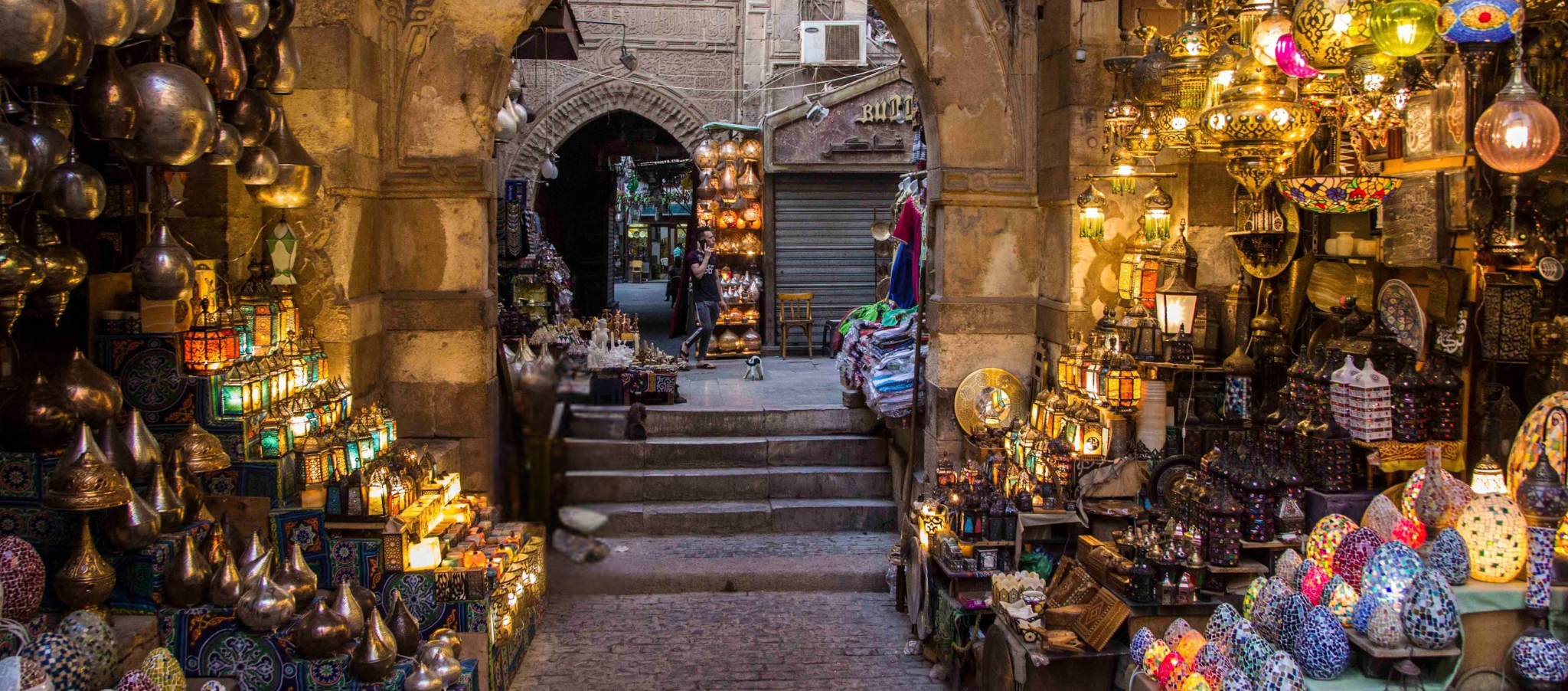
Khan El Khalili
Khan El Khalili is not a “go take photos” spot. It is a living memory.
Established in 1382 during the Mamluk period, the market has survived dynasties, invasions, modernization, everything. It was built as a commercial hub and it still functions that way. But in Ramadan, it shifts from commerce to culture.
You enter through narrow alleys and the lighting immediately changes. Lanterns hang above you in layers. Some are handcrafted brass, some colorful glass, some oversized and dramatic. Vendors sit outside their shops, not rushing you, just talking. The scent of spices mixes with incense. The sound of Quran recitation from nearby mosques blends into the crowd noise.
Al Hussein Mosque is a few steps away, and that alone changes the mood. After taraweeh, the entire area feels charged. People sit on plastic chairs outside cafés. Tea glasses never stop moving. El Fishawy Café, operating for more than two centuries, fills up fast. You do not go there for luxury. You go for the atmosphere of sitting in a place that has hosted writers, merchants, travelers, and entire generations during the same month.
Khan El Khalili is famous for traditional crafts, silver jewelry, copper trays, handmade lanterns, and that dense Islamic architecture that makes you feel like you stepped into another century. But what really makes it Ramadan-worthy is that it does not perform the month. It lives it.
Al Azhar Park
Al-Azhar Park tells a different story.
Opened in 2005, the park was built on what used to be a massive debris landfill accumulated over centuries. The transformation alone is dramatic. Today it is one of the largest green spaces in Cairo, stretching over dozens of acres with structured gardens, fountains, and panoramic viewpoints.
In Ramadan, the timing of sunset here feels intentional. You watch the sky change colors behind the Citadel. The call to prayer echoes across open space instead of bouncing between buildings. It is quieter, even when it is crowded.
Families arrive early to secure tables at the park’s restaurants. After taraweeh, people walk slowly along the elevated paths overlooking Old Cairo. The recent upgrades have made the experience smoother, better lighting, improved seating areas, more organized dining spaces.
Al Azhar Park is famous for its skyline view. You see domes and minarets in one direction and a modern city stretching in another. During Ramadan, that contrast hits harder. It feels like the city is layered in front of you.
If Khan El Khalili has intensity, Al Azhar Park is breathtaking.
Beit El Sehemy and the Zainab Khatoun Area
Beit El Sehemy sits quietly in the heart of Islamic Cairo, close to the historic house of Zainab Khatoun. These houses date back to the 17th century and represent traditional Ottoman-era domestic architecture. Wooden mashrabiyas, internal courtyards, carved ceilings, and rooms built around privacy and shade.
In Ramadan, this space becomes intimate in a different way. Cultural events are hosted inside the courtyard. Tanoura dancers spin under warm lighting. Traditional music fills a space that once hosted private family gatherings centuries ago.
You sit on wooden benches inside a historic house, not a commercial venue. The walls are thick. The doors are heavy. The air feels cooler. It is the kind of place where conversations lower naturally, where the performance feels respectful to the space.
This area is famous for preserving Cairo’s residential history, not just its mosques and markets. During Ramadan, it offers something rare, culture without noise. If you want a night that feels reflective rather than crowded, this is where you go.
El Korba, Heliopolis
El Korba tells a more modern story.
Developed in the early 1900s as part of Baron Empain’s Heliopolis project, Korba was designed with arcades, wide streets, and a European architectural influence that still defines it today. The buildings are symmetrical. The sidewalks are structured. The space feels intentional.
Ramadan in Korba is social. Not intense, not cultural quiet. Social.
After iftar, families walk under the arches. Cafés extend tables outdoors. Dessert shops stay packed. The lighting reflects off the cream façades and gives the entire street a warm tone. You can move easily between restaurants, grab dessert, then sit somewhere else for suhoor without needing a car.
Korba is famous for its architecture and for being one of the most walkable districts in Cairo. During Ramadan, that walkability becomes the experience. It feels organized but alive, busy but not chaotic.

 as a preferred source on Google